
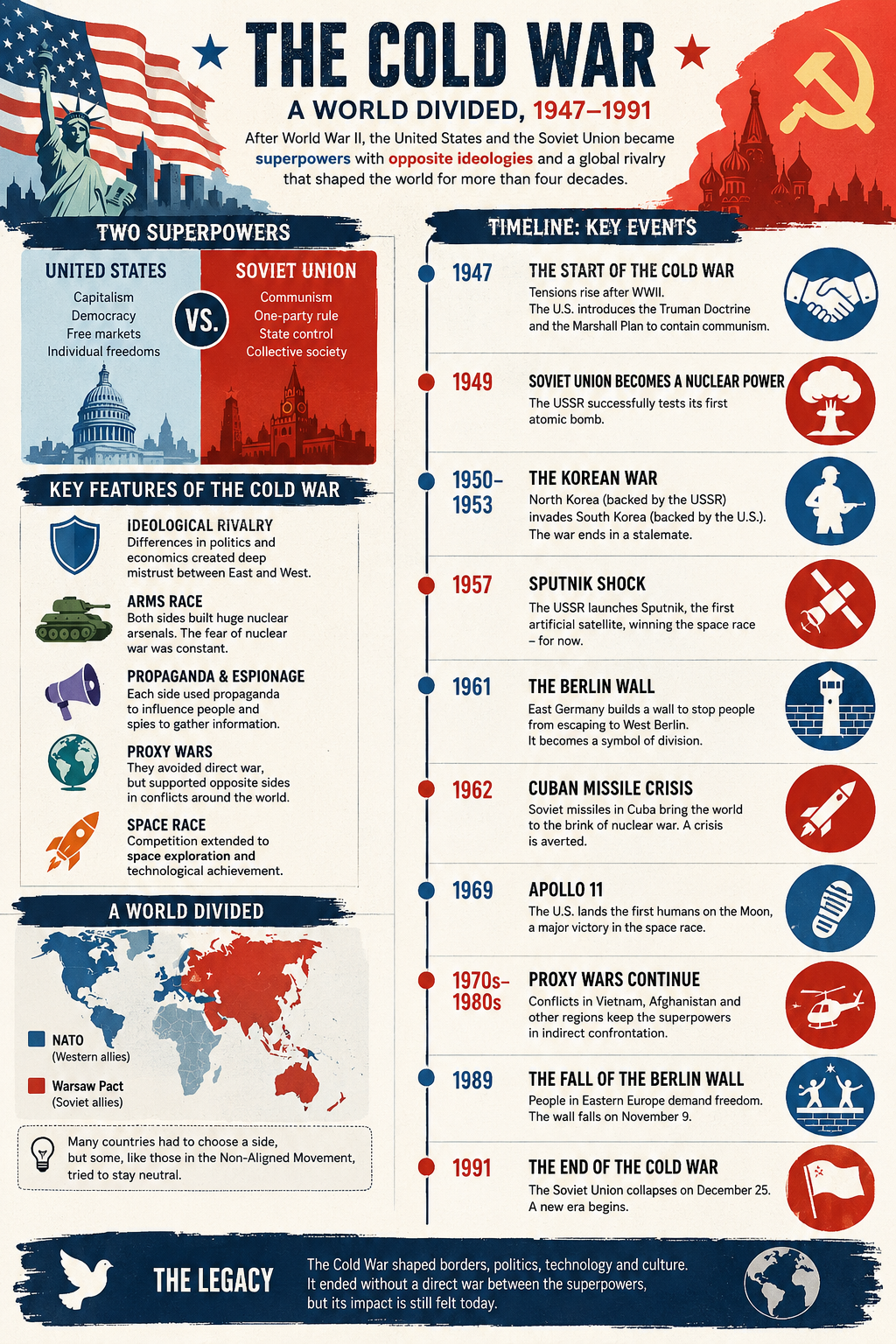
The Cold War was a period of tension and rivalry between the United States and the Soviet Union after the Second World War. It lasted from approximately 1947 to 1991. It was called a “cold” war because the two superpowers never fought directly in a large military conflict. Instead, they competed through politics, propaganda, economics, technology and smaller wars in other countries.
After 1945, Europe was divided into two different political and economic systems. The United States defended capitalism and democracy, while the Soviet Union supported communism and one-party governments. Countries such as West Germany, France and the United Kingdom were influenced by the USA, whereas Eastern European countries like Poland, Hungary and East Germany became part of the Soviet sphere of influence.
One of the most famous symbols of the Cold War was the Berlin Wall, built in 1961. Berlin had been divided into East Berlin, controlled by the Soviet Union, and West Berlin, supported by Western countries. The wall separated families and prevented people from escaping from East Germany to the West.
During the Cold War, both superpowers developed huge nuclear arsenals. People feared that a nuclear war could destroy the world. This situation was called the “balance of terror” because neither side wanted to start a war that would end in mutual destruction.
The rivalry also extended to space exploration. In 1957, the Soviet Union launched Sputnik, the first artificial satellite. Later, the United States answered by sending astronauts to the Moon in 1969 during the Apollo 11 mission.
Although the USA and the USSR never fought directly, they supported opposite sides in different conflicts around the world. Important examples include the Korean War, the Vietnam War and the Soviet invasion of Afghanistan. These conflicts are often called “proxy wars”.
Another important moment was the Cuban Missile Crisis in 1962. The Soviet Union placed nuclear missiles in Cuba, very close to the United States. For several days, the world feared a nuclear war. Finally, both countries reached an agreement and the crisis ended peacefully.
In the 1980s, the Soviet Union experienced serious economic problems. At the same time, many people in Eastern Europe demanded more freedom and democratic reforms. In 1989, the Berlin Wall fell, becoming a symbol of the end of communist control in Eastern Europe. Two years later, in 1991, the Soviet Union officially disappeared, marking the end of the Cold War.
The Cold War changed international relations, technology, culture and politics around the world. Even today, its consequences can still be seen in many countries.
QUIZ:
A. True or False
Write TRUE or FALSE. Correct the false sentences.
- The Cold War was a direct military war between the USA and the USSR.
- The USA defended capitalism and democracy.
- The Berlin Wall was built in 1945.
- During the Cold War, many people feared a nuclear conflict.
- Sputnik was launched by the United States.
- The Korean War and the Vietnam War were connected to the Cold War.
- The Cuban Missile Crisis happened in 1975.
- The Berlin Wall fell in 1989.
- The Soviet Union disappeared in 1991.
- The Cold War still influences the world today.
B. Answer the Questions
- Why was it called the “Cold War”?
- What were the main ideological differences between the USA and the USSR?
- Why was the Berlin Wall important?
- What was the “balance of terror”?
- What was Sputnik?
- What happened during the Cuban Missile Crisis?
- Why did the Soviet Union collapse?
- What event symbolised the end of the Cold War?
C. Discussion Questions
- Do you think the Cold War could have become a real nuclear war? Why?
- Which event from the Cold War do you find most interesting?
- How did the Cold War affect ordinary people?
- Are there tensions between superpowers today similar to the Cold War?
D. Vocabulary Match
Match the words with their definitions.
| Word | Definition |
|---|---|
| 1. Superpower | a. A barrier separating two areas |
| 2. Nuclear arsenal | b. A very powerful country |
| 3. Proxy war | c. Weapons using nuclear energy |
| 4. Wall | d. A conflict where bigger countries support other nations |

